


Charge your EV, your way
There’s more than one way to keep your EV moving. Whether you’re plugging in at home or powering up on the road, the right charging cable gives you more choice over where and when you charge.
Choose a Type 1, Type 2 cable or both, depending on your EV and how you prefer to charge. Explore the options below to find the right fit for your vehicle and the way you drive.
Type 1 EV home charger
By MotorOne

Power up wherever there’s a plug
Designed for charging your EV from a standard Australian power point, a Type 1 cable gives you a simple and convenient way to power up from the comfort of your own home. Ideal for single-phase charging, it’s an easy way to keep your EV ready for the road.
Additional specifications and benefits:
| Quality construction | High durability | Premium packaging | ||
Heavy duty cable construction with heat moulded hardware | Operating temp -35°C to +50°C | Comes in a heavy-duty oxford cloth bag with non-slip rubber backing | ||
| Power customisation | Charge time setting | |||
Adjust AMPS to suit your vehicle 6A/8A/10A | Set a charging time from the control panel |
Type 2 EV public charger
By MotorOne
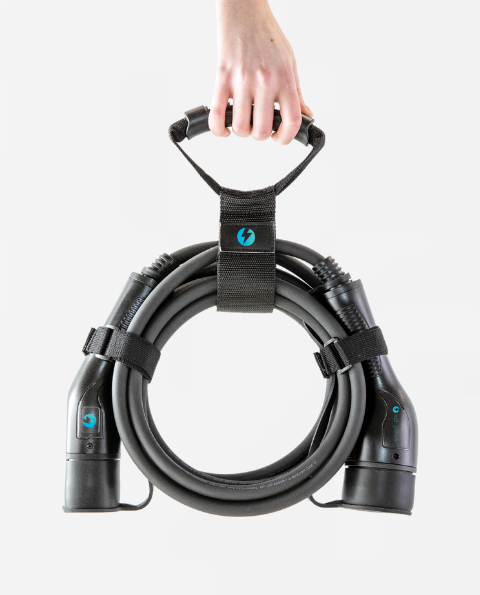
Spend less time charging and more time moving
Make the most of compatible Type 2 charging stations with a Type 2 charging cable, designed for faster AC charging at home and on the road. With single and three-phase options available, you can choose a cable that best suits your EV and your charging setup.
Additional specifications and benefits:
| On the road for longer | Protective covering | Premium packaging | ||
Up to 145km charge per hour | Impact & abrasion resistant, rated to 1.8 metre drop (casing will not crack/split/chip) | Comes in a heavy-duty oxford cloth bag with non-slip rubber backing | ||
| Charge in any weather | Ultra tough | Anti flaming casting | ||
| Weatherproof connector covers | Rated to 2500kg if run over | Thermoplastic flame retardant | ||
| 3 phase charging | High durability | |||
32AMP 22KW 3 Phase EV Charging cable (also compatible with 7KW single phase charging) | Operating temp -30°C to +60°C |
EV Cable FAQs
A 22kw electric vehicle charger needs a three-phase electrical connection, to charge at full capacity. You can still employ your 22kw charging cable with a 7kw singlephase charger, emphasising that the 22kw cable does need a three-phase supply for maximum speed. However, its compatibility with single-phase chargers offers you greater flexibility in selecting your charging station.
Yes it does. The Tesla Model 3 and Model Y AC charger is a Type 2 connector, often called Mennekes after its German manufacturer. Type 2 connectors can charge up to 22kw and are the most used AC connector in the world.
All EVs sold in Australia/ New Zealand use the Mennekes connection known as the Type 2 to Type 2 cable.
Yes it is however not all electric vehicles support up to 22kw charging. Refer to your vehicle specifications in order to determine if your car will accept up to 22kw.
A trickle charger provides charging through a standard power point (three-prong) 240V plug that comes with your EV. The other end is simply plugged directly into your EV. Doesn’t require installation of additional charging equipment. Can deliver 13 to 16km of range per hour of charging. By carrying an additional 22kw cable you can choose to install a home charger and use public chargers which may require you to supply your own cable (shopping centre, car park, at work, hotel).
You will receive a 5 metre heavy-duty 3 phase EV charging cable (rated up to 22kw), fastened by a velcro carry handle for easy handling. Stored in a strong Oxford cloth bag including a cleaning cloth and instructions. The cable will arrive to you ready for use.
One kilowatt (kw) is simply 1,000 watts. Kilowatts is the measurement of energy used for electric car chargers, typically 7kw, 22kw, 50kw, 350kw and so on. In other words, it’s the rate at which power is transferred from a charging station into your EV.
The bag keeps your cable safely secured and neatly stored away. The rectangle bag makes it easy to coil the cable into. It has a rubber backing to prevent is sliding around on your boot carpet.
The difference between a 7kw and 22kw EV charger is the rate at which they charge the battery. A 7kw charger will charge the battery at 7kw per hour, while a 22kw charger will charge the battery at 22kw per hour. The faster charge time of the 22kw charger is due to the higher power output.
A 5 year replacement warranty which excludes neglect, misuse and abuse.
PHEVs will never charge at 22kwh, usually maxing out at 3.7kwh. This is due to the battery cell in hybrid vehicles being relatively small. If it took in a charge at a speed any higher, it would overheat the battery and likely render it unusable long term.